
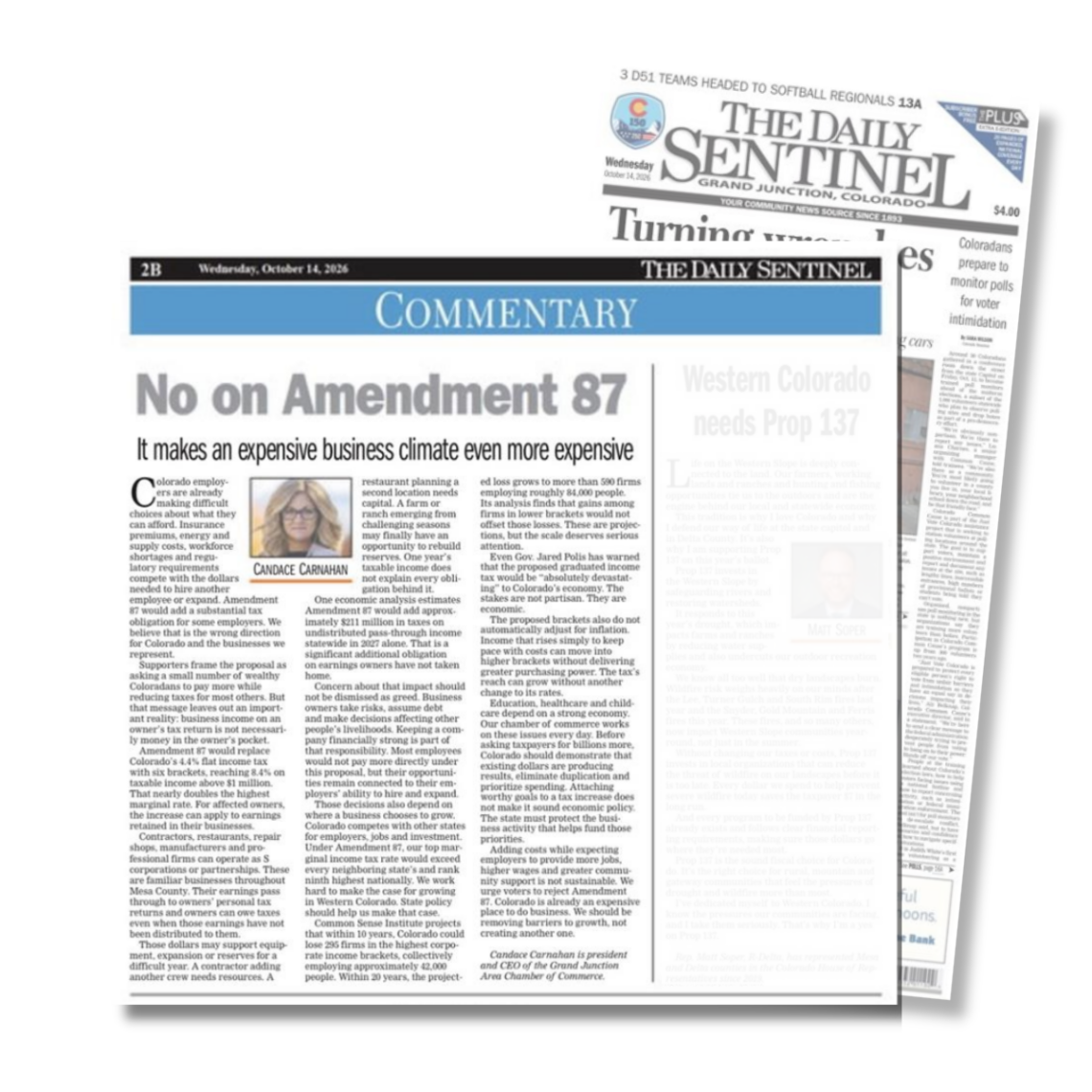
As printed in the Daily Sentinel on October 14, 2026
 Colorado employers are already making difficult choices about what they can afford. Insurance premiums, energy and supply costs, workforce shortages and regulatory requirements compete with the dollars needed to hire another employee or expand. Amendment 87 would add a substantial tax obligation for some employers. We believe that is the wrong direction for Colorado and the businesses we represent.
Supporters frame the proposal as asking a small number of wealthy Coloradans to pay more while reducing taxes for most others. But that message leaves out an important reality: business income on an owner’s tax return is not necessarily money in the owner’s pocket.
Amendment 87 would replace Colorado’s 4.4% flat income tax with six brackets, reaching 8.4% on taxable income above $1 million. That nearly doubles the highest marginal rate. For affected owners, the increase can apply to earnings retained in their businesses.
Contractors, restaurants, repair shops, manufacturers and professional firms can operate as S corporations or partnerships. These are familiar businesses throughout Mesa County. Their earnings pass through to owners’ personal tax returns and owners can owe taxes even when those earnings have not been distributed to them.
Those dollars may support equipment, expansion or reserves for a difficult year. A contractor adding another crew needs resources. A restaurant planning a second location needs capital. A farm or ranch emerging from challenging seasons may finally have an opportunity to rebuild reserves. One year’s taxable income does not explain every obligation behind it.
One economic analysis estimates Amendment 87 would add approximately $211 million in taxes on undistributed pass-through income statewide in 2027 alone. That is a significant additional obligation on earnings owners have not taken home.
Concern about that impact should not be dismissed as greed. Business owners take risks, assume debt and make decisions affecting other people’s livelihoods. Keeping a company financially strong is part of that responsibility. Most employees would not pay more directly under this proposal, but their opportunities remain connected to their employers’ ability to hire and expand.
Those decisions also depend on where a business chooses to grow. Colorado competes with other states for employers, jobs and investment. Under Amendment 87, our top marginal income tax rate would exceed every neighboring state’s and rank ninth highest nationally. We work hard to make the case for growing in Western Colorado. State policy should help us make that case.
Common Sense Institute projects that within 10 years, Colorado could lose 295 firms in the highest corporate income brackets, collectively employing approximately 42,000 people. Within 20 years, the projected loss grows to more than 590 firms employing roughly 84,000 people. Its analysis finds that gains among firms in lower brackets would not offset those losses. These are projections, but the scale deserves serious attention.
Even Gov. Jared Polis has warned that the proposed graduated income tax would be “absolutely devastating” to Colorado’s economy. The stakes are not partisan. They are economic.
The proposed brackets also do not automatically adjust for inflation. Income that rises simply to keep pace with costs can move into higher brackets without delivering greater purchasing power. The tax’s reach can grow without another change to its rates.
Education, healthcare and childcare depend on a strong economy. Our chamber of commerce works on these issues every day. Before asking taxpayers for billions more, Colorado should demonstrate that existing dollars are producing results, eliminate duplication and prioritize spending. Attaching worthy goals to a tax increase does not make it sound economic policy. The state must protect the business activity that helps fund those priorities.
Adding costs while expecting employers to provide more jobs, higher wages and greater community support is not sustainable. We urge voters to reject Amendment 87. Colorado is already an expensive place to do business. We should be removing barriers to growth, not creating another one.
Candace Carnahan is president and CEO of the Grand Junction Area Chamber of Commerce.