
 Not every economic shift announces itself with a headline, but that does not make it any less significant. Some of the most consequential changes happen gradually, as a series of decisions made over time begin to reshape the trajectory of a state’s economy.
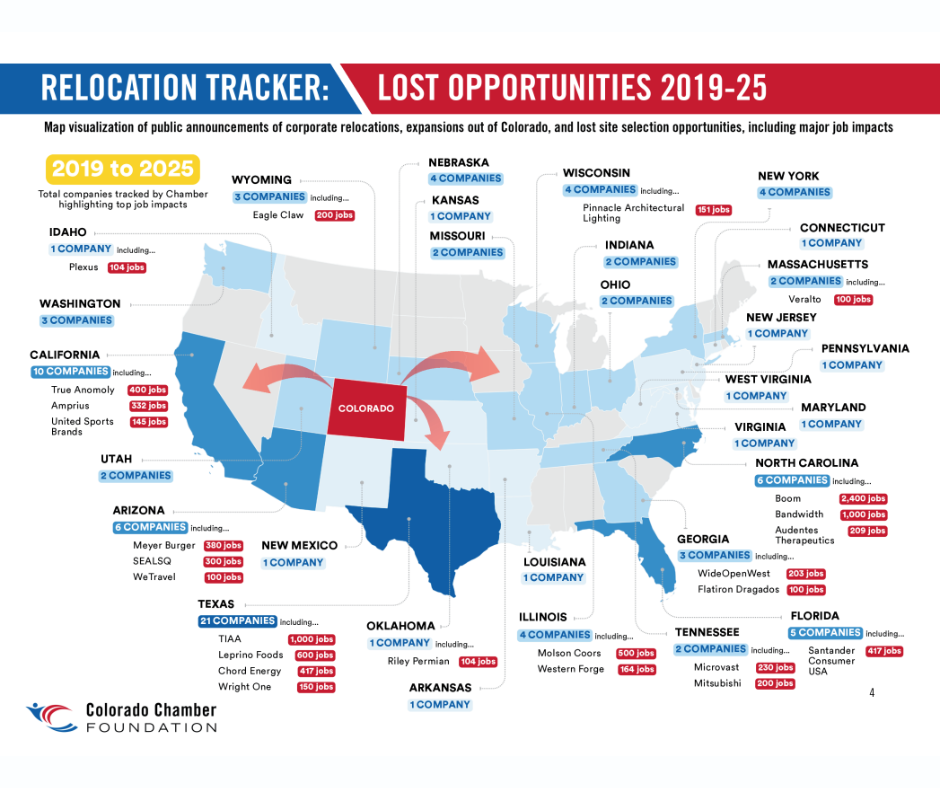
Our close partners at the Colorado Chamber of Commerce recently released a report tracking business relocations and lost opportunities, and the findings point to a trend that deserves our attention. Since 2019, nearly 100 companies have either left Colorado, reduced their footprint, or chosen to grow in other states, representing more than 13,000 jobs that could have been part of our economy. Just as important are the projects that never materialized here in the first place, with companies opting for states that offered a more predictable cost structure, workforce pipeline, or regulatory environment.
It would be easy to view this as a Front Range issue, but that would miss the broader reality. In Western Colorado, and particularly in Mesa County, we experience these shifts differently. Our community does not have the same margin for loss, and we work harder for every opportunity to attract and retain investment. When Colorado’s competitiveness weakens, the ripple effects are often felt more quickly and more deeply in regions like ours.
We have seen what this looks like in practice. Across the Western Slope, even incremental shifts in investment can have lasting impacts on a community’s workforce, tax base, and long-term stability. These are not abstract trends. They are real decisions made every day by employers weighing where to grow, where to invest, and where they can operate with the greatest level of confidence. At the same time, many of the most important stories are the ones we never see, projects that could have come to Western Colorado but ultimately landed in states where the path forward felt clearer and more sustainable.
That reality should prompt a broader conversation about how Colorado is positioned in today’s economic landscape. Businesses making long-term investment decisions are evaluating more than just geography. They are assessing cost, workforce availability, regulatory predictability, and overall risk. When those factors begin to shift, so do the outcomes.
None of this suggests that Colorado has lost its strengths. Our quality of life, natural resources, and entrepreneurial spirit remain strong. But those advantages alone are no longer enough to carry us forward without a consistent focus on competitiveness. That is not a static goal. It requires ongoing attention and a willingness to evaluate whether our policies are achieving their intended outcomes.
At the Grand Junction Area Chamber of Commerce, we often return to a simple principle, do no harm. It is a practical lens that encourages us to look beyond intent and consider impact. Well-meaning policies that add cost, complexity, or uncertainty can have unintended consequences, particularly for regions that are already working to overcome geographic and economic constraints.
For Mesa County, this is not about sounding an alarm for the sake of it. It is about recognizing a pattern early enough to respond thoughtfully. We have seen what is possible when communities, businesses, and policymakers align around shared goals. We also know how quickly opportunities can shift when that alignment is not there.
The question in front of us is not whether Colorado will continue to grow, but how that growth will be distributed and whether regions like Western Colorado will remain competitive in the process. Ensuring that we do requires a clear understanding of the challenges we face and a commitment to addressing them in a way that supports both our communities and our employers.
The trends outlined in this report are not inevitable. They are the result of decisions, and they can be influenced by the decisions we make moving forward. Recognizing that gives us an opportunity not just to respond, but to recalibrate in a way that strengthens Colorado’s economic future for all regions.
We encourage our business community, partners, and policymakers to take time to review the full report from the Colorado Chamber of Commerce and consider what it means for Mesa County and the Western Slope.
You can find the report here: https://cochamber.com/wp-content/uploads/2025-Relocations-Tracker.pdf
Because understanding the full picture is the first step in ensuring Colorado remains a place where opportunity does not quietly leave, but continues to grow.